 .
.Imagine & Sonic Wind LSRV
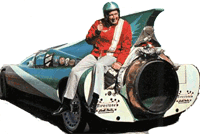
I have been working on the engine for Imagine LSRV and the driver’s capsule. The capsule is made of maraging steel and is shaped like a stretched out football. It has its own super sonic parachute system which is protected from explosion damage by being encased in a maraging steel protective cone. The encasement cone also acts as a deployment device to pull the chute out. I call it a “paracone’ because it is essentially a metal parachute.
I believe that any rocket propelled, man carrying vehicle should carry its pilot in a blast proof capsule. Rockets can blow up at any time and for no reason at all and spoil everyone’s day. Don’t believe me? Ask Burt Rutan. It has been a year since my friend Glen May was killed in an explosion developing the Spaceship 2 propulsion system rocket and they still don’t know how it happened or at least didn‘t bother to tell anyone like they said they would. So always encase your pilot in a capsule. Our capsule’s metal football shape will be wrapped with a composite wrap similar to Sonic Wind’s (which was 4 layers of ballistic fiberglass with a seam at every 90 degrees) in order to make it much stronger.
In the capsule the driver will be suspended in a webbing of Kevlar I will make from truck tie down straps. This webbing will be the seat for the driver and be stretched over a framework of chrome moly steel. This not only protects the driver from debris entering from behind but isolates him from vibration. Something very similar to this is used on Sam Wheelers motorcycle streamliner the “EZ Hook liner.”
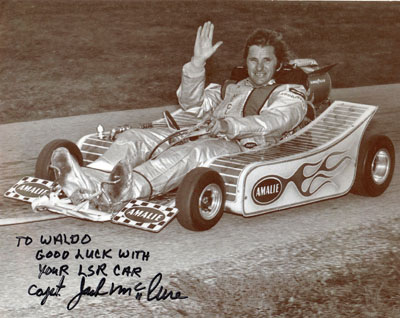
Just for fun I posted a photograph of the Captain Jack McClure’s rocket powered go cart I was telling you about last month so you can get an idea of how small it was. Do you want to drive this thing 220 M.P.H. in the quarter mile? I didn’t think so….
On an “I told you so note” I was in a book store the other day and found a new book which deals more into the sinking of the nuclear submarine USS Scorpion I was telling you about awhile ago. The new book is called “All Hands Down” and it is written by Kenneth Sewell and Jerome Preisler. I scan read the whole book and near the end they state that a Soviet rear admiral confessed to them that the USS Scorpion was sunk by a Soviet Ka-25 (NATO codenamed “Hormone”) Helicopter equipped with antisubmarine torpedoes. The helicopter was launched from one ship and then recovered on another ship in the fleet in order to hide the fact that it was missing some of its ordnance and to minimize witnesses. This was done because at that time (1968) the Soviet Navy thought that the US Navy had sunk the K-129.
The USS Scorpion was drawn to the area with the intent of sinking her in retaliation for the self sinking of the Soviet nuclear missile equipped K-129 submarine. Which went down 400 miles north east of Hawaii while making an attempted nuclear missile attack on Hawaii? The crew of the K-129 was trying to vaporize Pearl Harbor or Honolulu in order to start WW3. There were some politicos in the USSR that thought they could win a war with the United States back in 1968. They were wrong then and anyone who thinks the US is weak is wrong now.
I told you a year or more ago that this was probably what really happened and would come out sooner or later. I always stand on the truth unlike our politicians. So in essence two acts of war were committed by the Soviet Union against the people of the United States and the US Navy and the President of the United States did nothing but hide it from the population. My point is and always will be….The sad truth is that truth and righteousness have nothing to do with the real workings of this world.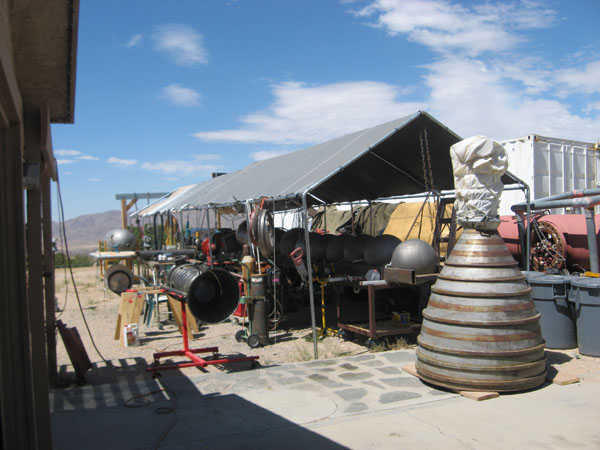 So much for that, if I don‘t stop writing about this now it will only turn into a rant. Anyway the American people really don‘t care about this nowadays anyway so why talk about it….
On a positive note, if you want to see a great series of videos on the land speed record look up “Bonneville” on You Tube. There are a couple of great video series there to watch which chronicle LSR history. There is a lot of footage I have never seen on past documentaries.
Many people wonder what my working conditions are like and where I build my machines so here are two photos of my shop and all the outside areas. The one photo is of Imagine LSRV under a long tarp roof. In front of it is a stock LR-105 rocket engine nozzle and combustion chamber. Next to it is the Imagine LSRV, LR-105 rocket engine on the engine stand. The other shot is what is essentially my garage. In it is a 12” metal lathe, a mill, a band saw and drill press as well as a tubing bender and many hand tools. It is primitive but I get a lot done because of the great weather in California. My partner Ken Mason owns most of the machinery but I get to use it.
I also traveled to Cleveland Ohio early in the month to visit relatives and take my elderly father and mother to see my mother’s sister Chris. My cousin Lisa (Chris’s daughter) was also marrying her fiancé Mark McNair. It was a beautiful ceremony in a beautiful large, old church. One thing that amazed me about Cleveland Ohio is how many large churches there are in that town. Denise and I wish the new Mr. and Mrs. McNair all the best in the world.
Thinking about jet cars lately I wanted to show you a model of a concept for a jet powered LSR machine I came up with a few years ago. I call it the “Silver Surfer” 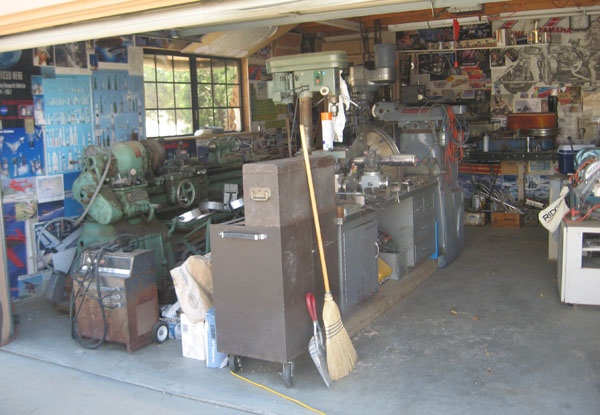 and it is named after my favorite super hero. I always liked this Marvel comics character because he was very cerebral and started off as a bad guy and then later became a good guy. Denise calls this jet car model the “Gecko” because it looks like a little reptile with its unsymmetrical stance. LSR cars are very much like lizards in that they are either lying perfectly still or they are bolting away at top speed. The lizards here in the high desert where I live are just like that. You will find them on a rock and they don’t move at all. Just when you are about to poke them with a stick they run away so fast you can barely follow them.
I have no plans to build a jet car but if I did it would look like this. It is a design that should have enough power if it were powered by a single Pratt and Whitney turbo jet engine from a Grumman Tom Cat to reach supersonic speeds and take the current LSR.
It is a design that would weigh 6,000 lbs. loaded and have nearly 27,000lbs. Of thrust running pump gas on afterburner. The biggest reason I never wanted to build a jet LSR car is because of their slow rate of acceleration. They tend to be heavy and spend as much as 35 to 40 seconds in the transonic range. This is very dangerous because there is much shock transition and shock propagation during this period. So the vehicle hunts for stability for a long time and could go out of control. I would prefer a jet car that accelerates like a rocket and the key to this is low weight, low drag, great engine air flow and a high thrust to weight ratio. The Silver Surfer or Gecko design incorporates all these things.
The engine gets good air because the intake is in the very front. The bottom of the intake is pulled out to keep the engine from getting fod (foreign object damage) damaged and forms a supersonic point to penetrate dense compacted air. The single front wheel is in the intake in a composite shroud.
I have seen many different jet car designs where the air intake is in various locations. Some have air intakes on their sides; this is bad because the air behind the intake is 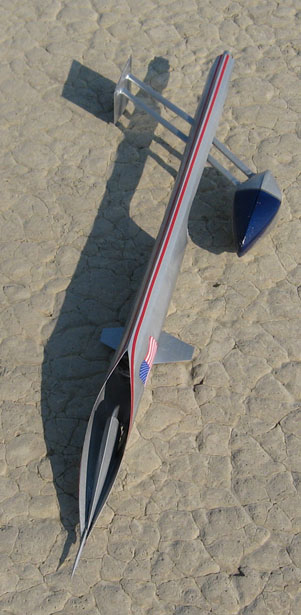 usually turbulent and the rest of the vehicle air flow behind the intake has become non laminar. So the vehicle drag goes way up. Aircraft designers put side mounted air intakes in front of the wing roots because they know the drag is going to be high there anyway. Some LSR car designs in the past have had the intakes on top and all these cars will eventually fly because the air is pulled into the engine so fast that a low pressure area will be created over the nose and lift it up.
Craig Breedlove’s 1965 car had the air intake on top of the nose and canopy and even though they ended up putting canards on the side of the nose as big as coffee tables the nose was still flying at 600 m.p.h. So much so that the front wheels were barely touching the ground at speed. So even though the car had a supersonic speed potential in design, 600 M.P.H. was all they would dare try for. I told Craig he should have cut down the ten foot tall rear tail which was behind the rear wheels acting like a lever and maybe that would have helped. Craig said they thought about that later but not for many years after the fact.
Art Arfons's last jet car the Green Monster #27 was designed with the intake on top of the nose and canopy. Tim Arfons told me it was running between 370 and 400 M.P.H. and the canards on either side of the nose were at full deflection. So the car was on the verge of flying and this is why Art finally retired, not because he was afraid of the car. Everyone I have ever met who knew Art personally said that Art literally had no fear. He just lacked that emotion.
The body of the Silver Surfer is an aluminum monocoque wrapped around the engine and uses the engine as its main structural member. Two large tubes mounted above and below the engine carry the loads of all the other components. This saves weight as the driver capsule/wheel spat combination on the left side is made of composite as well as the opposite wheel spat or fairing. The streamlined struts that hold the two spats to the car utilize NASA scissor wing (look it up) aircraft technology to lower drag and present a lower frontal area. The tubes do no move but both sides impart the same amount of drag even though the right wheel is way out and swept back. This also spreads the vehicle weight over a wide footprint on the playa to aid in dynamic stability. The driver is also located nearer the Cg so he gets a better feel of what the car is doing as well as being far enough to the rear to see changes in direction quickly so he can compensate for them.
Later in the month I spent three days watching and helping the North American Eagle crew run at El Mirage dry lake. I fodded the lake bed and set up course markers which I had made for Sonic Wind. I have told you a lot about this team and machine in the past and things are looking up for the NAE crew. The big red jet car was making runs in the 300 M.P.H. range which is all they could hit because of the short length of the lake bed. There is very little room to stop on a three mile long lake bed after you hit 300 m.p.h.
El Mirage is a great lake to test a new vehicle because of its flexible and at the same time solid surface. The lake bed is a great “tell” lake. If you run a vehicle (especially one with metal wheels) and walk back through the tracks you made on the lake bed and know what you are looking for and at, the lakebed will tell you more of what your car is doing than any electronic strain gauge or transducer data you could ever gather.
The NAE team tested many of their new systems as well as the new metal wheels made by engineering and fabrication wizard Steve Green of Canada. The NAE team is made up of Americans as well as Canadians thus the name North American Eagle. Everything seems ready for a real attempt on the 1997 Thrust SSC land speed record. I will keep you updated but if you want to see what they are up yourself go to their site on our links page at www.landspeed.com. I posted a photo of what the big NAE jet looks like at speed. It is quite a sight.
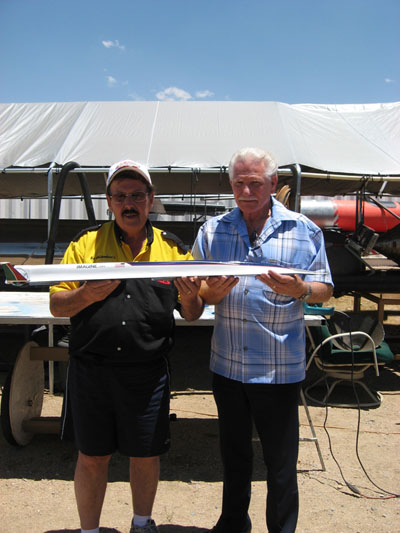
Another neat thing that happened was that I was visited by Ky Michaelson and Captain Ed Ballinger.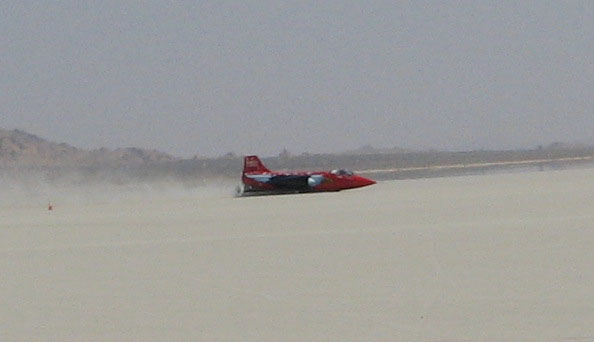 Ky needs no introduction but Captain Ed Ballinger was a rocket dragster pilot back in the 1970s. He drove Ky’s Conklin Comet H2O2 rocket dragster which hit 348 M.P.H. and 4 second elapsed times in the 1/4 mile. If you know Ky, he is the best story teller I have ever met and has done and tried just about everything so he is quite entertaining to talk to. I posted a photo of Ky and Ed Ballinger holding the Imagine LSRV model at my work area.
Getting back to the Silver Surfer design, it is a great and logical design; the only problem is now where in the world would you get a good running Grumman F-14 Tom Cat engine. Well, it just so happens Tim and Art Arfons has two of them just sitting in their shop stuffed in a corner.
While I was in Ohio I had also planned to visit Art Arfons's shop in Akron about 40 miles away. Tim and Dusty Arfons want to turn their dad’s shop into a museum for motor heads and historians of speed to enjoy forever. I can’t think of a better idea as I was giddy walking through Art’s shop. For me it was like walking through Leonardo DaVinci’s workshop and going through his personal stuff. It was hallowed ground for an LSR obsessed guy like me. I like to come off as a hip, been everywhere, seen everything kind of dude but sometimes I can also act like a little kid. This was one of those times.
As a treat for you LSR heads Ed Torsello our web master put together a photo page you can link to off the home page to see what Art Arfons's shop looks like. The shop has been left exactly the way Art left it before he died. Tim and Dusty said you can get a photo of the shop taken in the 1960s and all the same stuff is still on the walls in the exact same place just like in the old photograph. This way Art knew where everything he needed was all the time.
Tim, Art’s youngest son had set it up for me to see the shop and be taken through it by his younger sister Dusty. Dusty is Art’s only daughter and is famous in the tractor pulling sport as “The Dragon Lady”. She drives a pulling tractor powered by two Lycoming T-55 turbine engines. It is a constant winner and throws twin flames thirty feet into the air to thrill the crowds. So she is pretty famous in her own right. Art and wife June who is still alive and well had another older son Ron who died at the age of 58 of a massive heart attack.
Dusty met Denise and I with her two sons Jake and Lane while her husband Randy was cutting the grass at the rear of the shop. She took us through the shop which was a series of metal buildings linked together with a common roof. There were dozens of jet and turbine engines all over the place. A heavy odor of hydraulic fluid and oil which was on the floors and on most things and literally tons of aircraft hardware and hoses hanging on all the walls. The groups of buildings were in two sets. The two sets of buildings were separated by a grass open area about forty feet wide which was littered with turbojets and hardware.
At one time in the 1960s Art’s older brother Walter built his own dragsters, jet dragsters and rocket cars in the shop right across the lot and because the two brother’s had bad blood between them they would never talk to each other. They would pass by each other all day long and never speak even though their shops were only forty feet apart. Later, Walter retired and moved to Florida and Art took over the entire place. Currently Walter has moved back to Akron and is in his 90s.
Walter built the 1964 LSR holder the J-46 jet powered “Wingfoot Express” which was driven by Tom Green. Later he built the 25 (25,000 lbs. of thrust) JATO rocket powered 1965 “Wingfoot Express” driven by Bobby Tatro. Later he experimented with a steam powered rocket dragster called the “Neptune” as well as dozens of jet dragsters and turbine vehicles which all used the “Green Monster” moniker. I believe Walter was actually the one who built the first jet powered dragster in the United States while Art was still running piston powered dragsters with the Allison V-12 aircraft engine. The Russians actually built the first jet powered LSR car in the late 1950s.
Walter and Art started building drag cars together back in the 1950s originally working as a team but something happened which is not very clear to me even to this day ( it’s none of my business anyway) and they both went their separate ways. Many times through the years they would even compete against each other at a drag meet, pushing their cars to their limits and taking extra chances in order to beat each other. Walter’s son Craig Arfons was also a jet car and jet boat racer. He held the ¼ mile record for jet dragsters (324 M.P.H.) in a J-85 powered dragster and raced around the country for many years. Sadly he died in the 1980s while attempting to set a new water speed record on lake Sebring, Florida with his J-85 powered jet boat the “RainX Challenger.” He was in his early 40s. This is another reason why I hate naming anything the “Challenger“. Challenger to me means “wanna be“…. Now think of vehicles with that name and think of what they attained.
Also in the shop standing against the wall there were two T-40 turbines from the famous vertical takeoff turboprop planes the Convair “Pogo” and the Lockheed “Salmon”. These engines would make one hell of a wheel driven LSR car that is if you could overcome the gear problems for which they were famous for. The T-40 is basically two midsize turbojet engines, linked together through a gearbox that culminated in a single counter rotating output shaft.
The collection of historic aircraft engines in Art’s shop is amazing. There are two Early Grumman F-14 Tom Cat fighter jet, Pratt and Whitney turbofans standing in a corner. There is an Allison W-24 which was an experimental 24 cylinder airplane engine (created by linking two V-12 Allison aircraft engines together at the crankshaft) destined for the new propeller driven fighters being developed at the end of the World War 2. Of course the jet engine made all those piston engines obsolete towards the end of the war. There are numerous helicopter turbine engines and jet fighter engines on wall racks or lying on the floor. Many, even though I know a lot about jet engines, I couldn’t identify.
Art’s business was jet drag car racing or land speed racing but his hobby was to get old airplane piston engines like the Ranger and have neat wooden props made for them. Then he would mount them on a steel frame work, kind of like a test bed and run them just to watch them run. There are a few engines set up like that around the shop. Art had custom wooden propellers built for these engines to spin as they ran.
There are many trophies lying about and many large pictures of Art’s vehicles on all the walls. There is oddly a large photo of a twin rotor helicopter possibly a “Chinook” towing a ship or barge through some pack ice. I put this in the photo page because I couldn’t believe it myself and thought you should see it. Art had this one in his office and I can see why. If you want to see excellent chopper piloting look at the angle of that chopper and how close those blades are to the ice. Now remember the tow line comes from the SIDE of that chopper! Think you are a good chopper pilot?
Hanging on a trophy are Art’s goggles (missing a lens) which Art wore in his famous 1966 crash at Bonneville in The J-79 powered jet Green Monster which he crashed at a speed of between 610 and 615 m.p.h. Tim said people get 585 m.p.h. as the crash speed because that was what his average speed was through that mile on the time slip but the trap speed where the car went out of control was 615 plus m.p.h. The crash was the result of a bearing which had seized from lack of lubrication, burning the axle off and tossing the car end over end. The tail fin of that 1964-66 car is hanging up and other than the notorious melted bearing are the only parts left of the famous 3 time LSR holding Green Monster.
Many people believe that that particular car was rebuilt into the Green Monster which was sold to Slick Gardner and Campaigned in 1978 with Gardner as the driver. It was named the “Anderson Pea Soup Monster” because Anderson Pea soup sponsored the campaign. But Tim says that this is not true as the entire 1964-66 car was hauled off to the scrapper as it was totally destroyed. The car Slick Gardner owns is an entirely different machine and doesn’t have even a single piece from the 1964-66 Green Monster. You can see this newer Green Monster at the Peterson Museum in Los Angeles where it is currently on display.
Tim Arfons makes his living using turbojet engines to dry NASCAR race tracks off when needed in case a sudden down pour ruins the race day. So he is traveling around the country most of the time. Tim also sells jet and turbine engines to various clients. He says if he were to build a LSR car it would have a J-58 engine in it. A pair J-58s is what powers the famous Lockheed SR-71 Blackbird, A-11 and YF-12, Mach 3 aircraft. He still has his hand in drag racing as there is a new and unpainted jet dragster under construction in one of the shop buildings.
In one of the buildings was a very large machine which had the ability to cut, grind, drill and sand metal. It looked like a huge workout machine one would find in a gym. Only it is painted green and used to work metal instead of muscle. Art built it and had a pet name for it. It was called “Art’s make anything machine” and when you look at it you will see that that is the perfect name for it.
Next Dusty showed us Green Monster #27 which was in a trailer. It looked just as I remember it when I was saw it at Bonneville in the early 1990s. In fact when you watch the documentary about Art’s life put out by David Hess (a documentary producer who never returned photos I lent him, Thank you very much.) I am standing behind Art when he tells Jim Deist that he is done with driving and is packing the car up. That was his last run at Bonneville and the end of an era.
As we went around the side of the buildings to meet Dusty’s husband Randy who I remembered as one of Art’s crew at Bonneville. We saw what was left of a centrifuge Art had built for himself in order to acclimate himself against the extreme G forces of his LSR cars. Franklin Ratliff had helped Art design it many years ago. It is very similar to the one used by NASA to acclimate our astronauts to high G forces. Centrifuges are basically a cabin on a long steel arm which is set spinning by an engine. The pilot is whirled around and forced into taking positive G forces. You have seen them on every space documentary or movie about astronaut training. The arm on this one has been torched off but I don’t know why.
I had asked Tim if I could use the Arfons's Green Monster colors of green, white and red on the tailfins of Imagine LSRV as a tribute to the guy who got me hooked on the LSR and he said that would be fine. That is why the tail fins on the model are painted those colors and not because I am ¼ Mexican.
I could have gone on asking questions of Dusty and Randy all night but the sun was setting and the nosey Californian “me” had taken enough of their time. Dusty and Denise hugged goodbye and I said so long to the boys. As we walked to our car I wondered if the Arfons family legacy of speed was over. Waving goodbye I see two young healthy boys, a tough, racer mom, a land speed crew father and an uncle with dozens of turbojets lying around his shop and I wonder…Who knows?….Waldo
Click on the image to veiw Arfons's Shop